
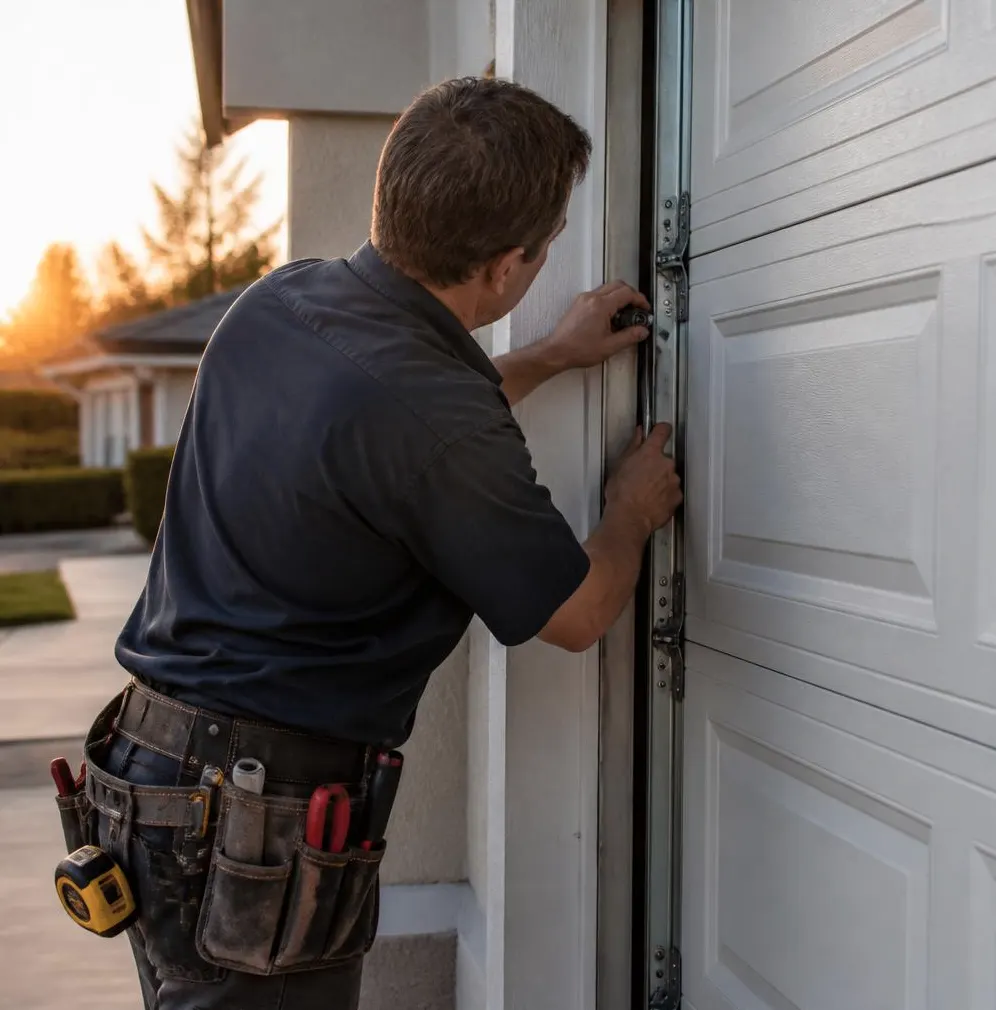
What a Technician Sees After a Windstorm
A typical call after a rough afternoon storm starts the same way: the homeowner heard a loud bang, went to check, and found the garage door bowed outward between the panels or popped clean off one of the tracks. Sometimes it's subtler — the door still closes, but there's a new gap at the top corner, a roller hanging loose, or the opener strains because the track got nudged out of alignment. In South Shore Tampa Bay, where wind gusts off the bay and sudden squalls are routine from June through November, these calls spike right after any serious blow comes through.
The pattern is almost always the same: the door held fine for years under normal use, but a sustained gust plus one weak point — an aging spring, a loose track bracket, worn rollers — was enough to let the wind win.
Why the Garage Door Is a Home's Weakest Wall
Most exterior walls are short spans of solid material. A garage door is the opposite: a wide, mostly unsupported panel, often 16 feet across, held in place by thin tracks and a handful of hinges and rollers. When wind hits a closed house, pressure builds up inside and pushes outward in every direction, including against the garage door from the inside. If that door isn't rated to handle the load, it can bow, buckle, or blow in entirely.
Once a garage door fails, wind rushes into the structure and pushes upward on the roof from underneath — which is how homes end up losing roof sections in storms that otherwise would have caused mostly minor damage. That's the real reason insurers and builders pay so much attention to garage door wind ratings in this part of Florida: it's not about the door itself, it's about everything behind it.
Signs Your Door Won't Hold Up
- Panels that flex or show a visible wave when you push on them by hand
- Tracks that aren't bolted tightly to the frame, or brackets with rust starting at the mounting points
- Rollers that are cracked, flat-spotted, or grinding instead of rolling smoothly
- Weatherstripping that's split, shrunk, or pulling away, letting wind-driven rain in during afternoon downpours
- A door that's more than 12–15 years old with no reinforcement and no documented wind rating
What to Check Before the Next System Rolls Through
- Inspect tracks and hardware. Every bolt and bracket should be snug. Humidity and salt air speed up corrosion on fasteners, so a bracket that looks fine from a distance can be loose underneath.
- Test the springs. A door with a weak or unbalanced spring puts extra strain on the opener and tracks right when wind load is highest. If the door feels heavy or drifts when disconnected from the opener, the springs need attention before storm season peaks.
- Check for rust and swelling. Wood and composite doors swell with humidity and can stick or bind; steel doors can rust at seams and hinges. Either problem weakens the door's ability to flex and recover under pressure instead of cracking.
- Confirm opener backup power. Power outages are common during storms. A battery backup on the opener means you're not stuck manually wrestling a heavy door in high wind.
- Consider a bracing kit if your door isn't wind-rated. Horizontal or vertical bracing kits reinforce an existing door for a few hundred dollars, a cheaper short-term fix than full replacement, though a code-rated wind-resistant door is the longer-term solution for homes closer to the coast.
When to Call Ruskin Garage Door
If your door shows any of the warning signs above, or you simply don't know how it would hold up in sustained wind, it's worth having it looked at before the next storm, not after. Ruskin Garage Door handles garage door maintenance and tune-ups to catch loose hardware, worn rollers, and corrosion early, and garage door spring repair for doors that feel off-balance or heavy. For older doors without a wind rating, we can also talk through reinforcement or full replacement options suited to South Shore weather.
Call Ruskin Garage Door today to get your garage door storm-ready before the next system moves through Ruskin, FL.